- Today
It Takes Complexity to Beat Complexity
- Randall Rogers
- 0 comments
From Week 2 of Leading Through Complexity
Week 2 of Leading Through Complexity opens with a principle that sounds abstract but turns out to be intensely practical. Complexity leadership theorist Mary Uhl-Bien puts it this way: it takes complexity to beat complexity. A system must possess complexity equal to that of its environment in order to function effectively.
This is known as the law of requisite complexity, and here's how I translate it for practitioners. Say you're streamlining an end-to-end process that spans multiple departments and units. You can't streamline that process by only having a couple of those departments or units participate in the change effort. You need them all to participate. Bringing them all in raises the complexity of your team arrangement, and that's exactly the point. You're matching the complexity of the environment you're trying to change.
Technical or Adaptive? It Matters
Most organizational challenges are a BOTH/AND condition. They have technical parts, which are clearly defined, have been solved before and yield to expertise and step-by-step methods. They also have complex adaptive parts, where people can't even agree on what the problem is, existing know-how doesn't provide the answer, and solutions emerge only when diverse people learn together.
If there's one thing I'd like you to take from Week 2, it's this: our approach to solving organizational challenges matters.
The Single Biggest Failure of Change Leadership
Ron Heifetz, one of the first people to write about adaptive leadership, named the most common mistake I see in our field: the single biggest failure of change leadership is to treat a complex adaptive challenge with a technical solution.
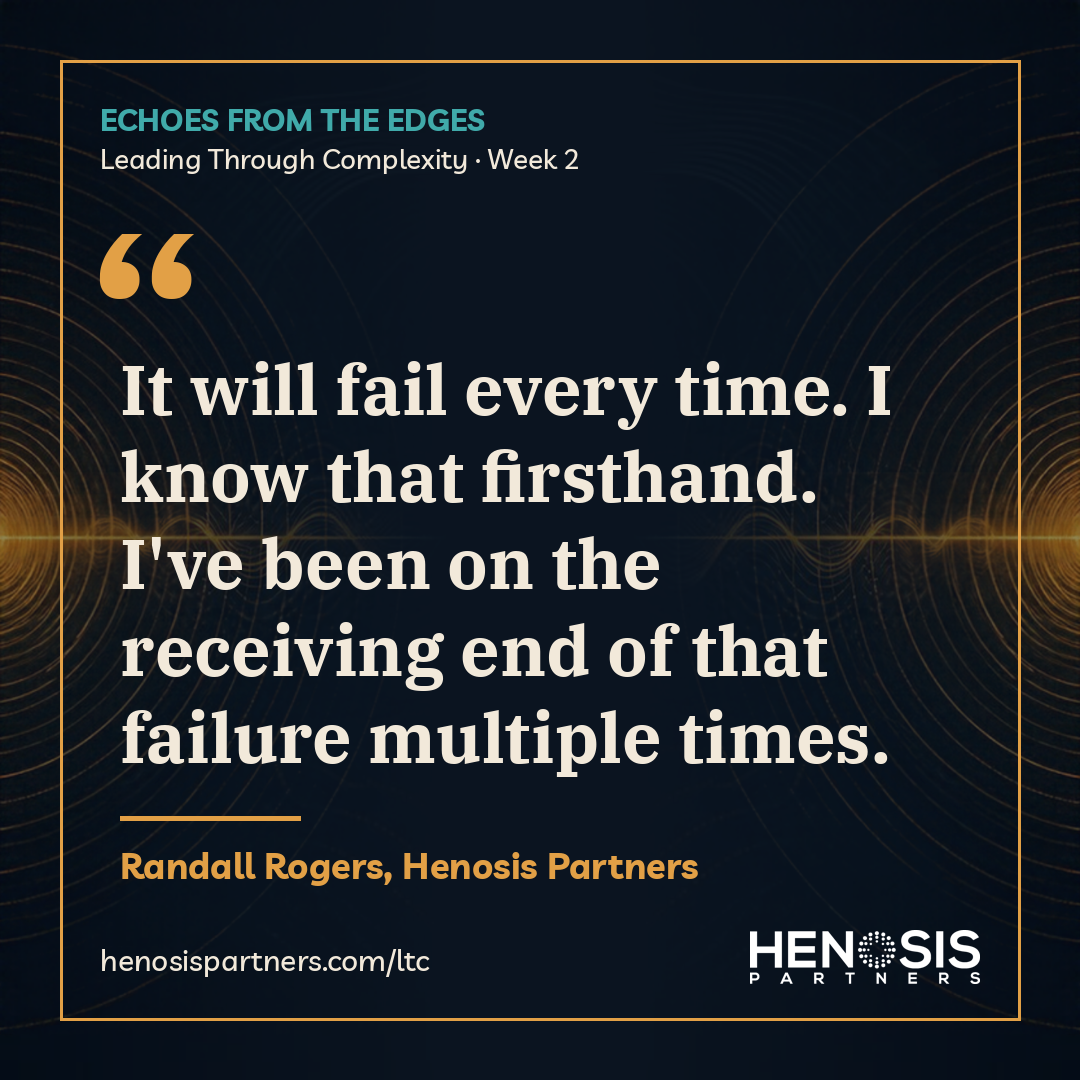
"It will fail every time. I know that firsthand. I've been on the receiving end of that failure multiple times."
Why do we keep making this mistake? Because we've all been culturally conditioned to look at complex challenges through a complicated lens. And when we do that, the lens expects a solution.
It almost demands a solution. So we reach for a new process, a new system, a training program, a reorganization, and we watch the old patterns return.
The costs are predictable: overly rigid plans, oversimplified issues, excluded perspectives, no shared understanding of the real problem, little ownership from leaders or the front line, more resistance, slower change and wasted resources. Nora Bateson captures the alternative beautifully: the shape of the response needs to meet the shape of the trouble.
Cynefin: What Kind of Challenge Am I Dealing With?
The tool I've found most helpful for separating the technical from the adaptive is the Cynefin framework, from the work of Dave Snowden and The Cynefin Co. Cynefin is a Welsh word that evokes a habitat, and it's a good metaphor. Most real challenges contain several habitats at once.
Clear and complicated (the ordered domains) are knowable and predictable. Best practice, good practice and expertise work here.
Complex is where cause and effect can really only be understood in retrospect. Here we probe, sense and respond: we experiment, notice what happens and amplify what works.
Chaotic is where we act first to stabilize, then sense and respond.
In the middle sits confusion, where we don't yet know which domain we're in, sometimes without even realizing we're confused.
I keep a Cynefin job aid on my desk. Whenever leadership hands me a challenge, I keep asking myself: What type of challenge am I dealing with? What parts are technical, and what parts are complex adaptive?
A Better Way: Expose, Amplify, Integrate
If technical fixes don't work on complex challenges, what does? In Week 2, I introduce the Complexity Leadership Model (CLM), built around three strategies: we expose difference, amplify difference and later integrate difference.
Each strategy has its own sequence. The diagnostic sequence surfaces narratives, patterns and weak signals. The dialogic sequence brings diverse perspectives into generative conversation.
The experiential sequence moves forward through safe-to-fail experiments. Underneath them all runs a simple change framework: shared understanding, then shared intention, then aligned actions, with relationships transforming all along the way.
"As you'll learn, as I hope you'll learn, the secret is in the sequence."
And at the heart of the experiential sequence is PEARL (Plan, Experiment, Assess, Reflect, Learn), the inner flywheel of change that keeps the system learning.
Try This
Take one challenge on your plate this week and split it into parts. For each part, ask: is this clear, complicated, complex or chaotic? Then check your plan.
Are you applying expert, step-by-step solutions to the complex parts? If so, you've found where the next experiment belongs.
Watch the Short
Watch on YouTube: The #1 Mistake in Change Leadership
Subscribe to Echoes From the Edges for more: Echoes From the Edges on YouTube
More From This Series
Keep Learning
Want a practical starting point? Download the free Hybrid OD e-book and see how diagnostic and dialogic methods combine to tackle complex change.
Ready to go deeper? Leading Through Complexity is our live 12-week program for OD, change and transformation leaders. The next cohort begins in 2027 and is limited to 50 participants. Join the waitlist.