- Today
Stop Making Change Happen: Create the Conditions for It
- Randall Rogers
- 0 comments
From Week 6 of Leading Through Complexity
Most of us were trained to make change happen. Define the future state, build the plan, secure sponsorship, communicate, train, reinforce. It's a direct route, and it's the road most traveled.
In Week 6, we take the road less traveled: creating the conditions for change to occur. This is about collaborative change, where you as the complexity leader design the environment in which people can transform their own system rather than pushing change onto them.
Taking Context Seriously
Creating the conditions for change starts with taking context seriously. No two contexts are the same. Remember the river from Week 5: you never dip your toe into the same organizational river twice.
That has an uncomfortable implication for best practice. What worked brilliantly in one organization, or one division, or even one quarter, may not work in the next. Philosopher Alicia Juarrero describes this as solutions that do not commute. Instead of importing an answer, we create conditions where the right answer for this context can emerge.
Generative Containers
The primary way we do that is by designing a generative container: a space, physical or virtual, a single event or a series, that holds people and ideas together long enough for something new to emerge.
A good container gathers a requisitely diverse group around a complex challenge that genuinely matters to them. It holds the past, present and future in the same conversation, and it gives people enough safety to say what's really true and enough structure to make progress.
Think of the difference between a typical change kickoff (slides, Q&A, a few polite questions) and a well-held working session where people from across the system map the challenge together, challenge each other's assumptions and leave with experiments they designed themselves. Same people, very different container.
Constraint Regimes: The Hidden Architecture
What makes a container generative? Constraints, but not the kind most people imagine.
In complexity thinking, constraints aren't just limits. Enabling constraints shape how people interact and make certain kinds of conversation more likely. Who's invited, the question you pose, how the room is arranged, how long people stay with a question before converging, what rules govern turn-taking: all of these are design choices.
In Week 6 we look at how to build a container from a set of constraints working together, a constraint regime. When you learn to design them deliberately, your practice changes.
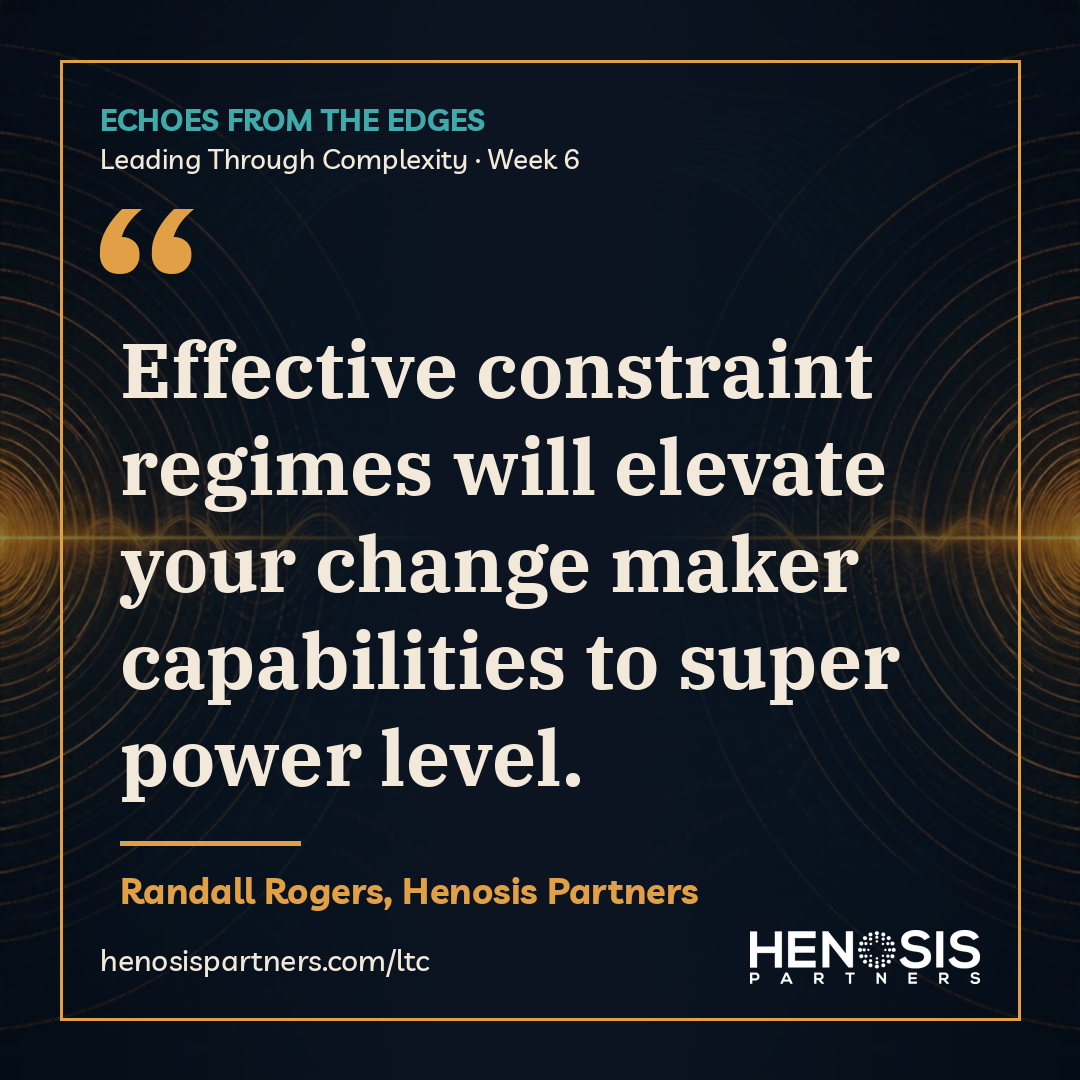
"Effective constraint regimes will elevate your changemaker capabilities to superpower level."
Facilitating from the Balcony
Once the container is designed, the complexity leader's role is to hold it. That calls for a particular facilitation stance.
You're a process expert, not a content expert. You don't engage in the content or try to impose your views, opinions or agendas on the group. People find meaning and patterns for themselves, without manipulation and without a facilitator imposing a framework on them.
The goal is to be invisible, to have a zero footprint, almost to operate from the balcony, watching the dance floor and adjusting the conditions rather than leading the steps.
"We want to manage the process, not the people."
The methods we use are about changing interactions. When interactions change, patterns change. And when patterns change, the system changes, in ways that the people inside it own.
Why the Indirect Route Works Better
It can feel slower to create conditions rather than drive outcomes. In practice, the opposite is usually true. When people shape the change themselves:
resistance drops, because nobody is resisting their own ideas;
adoption is faster, because the people doing the work designed it; and
results last, because the ownership sits in the system rather than with the change team.
This is what I mean when I say the CLM delivers fast change with little to no resistance that sustains over time.
Try This
Before your next workshop or meeting about a change, design three constraints on purpose: who will be in the room (and who's missing), the one question you'll hold the group to, and one rule for how people will interact (for example, everyone writes before anyone speaks). Then watch how the conversation shifts.
Watch the Short
Watch on YouTube: Facilitate From the Balcony
Subscribe to Echoes From the Edges for more: Echoes From the Edges on YouTube
More From This Series
Keep Learning
Want a practical starting point? Download the free Hybrid OD e-book and see how diagnostic and dialogic methods combine to tackle complex change.
Ready to go deeper? Leading Through Complexity is our live 12-week program for OD, change and transformation leaders. The next cohort begins in 2027 and is limited to 50 participants. Join the waitlist.
FREE MINI COURSE: Go deeper with The Age of Complexity
6 short video lessons (about 33 minutes) from Leading Through Complexity on why proven change methods fail, and what to do instead.
Get the Free Mini Course →