- Today
Why Old Patterns Keep Coming Back: Attractors and Culture
- Randall Rogers
- 0 comments
From Week 9 of Leading Through Complexity
Every change practitioner has seen it. The workshop goes well, the pilot succeeds, the new behaviors take hold, and six months later everything has drifted back to how it was. We usually call this "resistance." In Week 9, we look at it through a different lens: attractors.
An Attractor Is Not a Thing
The word is misleading, so let's start there.
"An attractor is not a thing that is doing the attracting. It's more of a pattern."
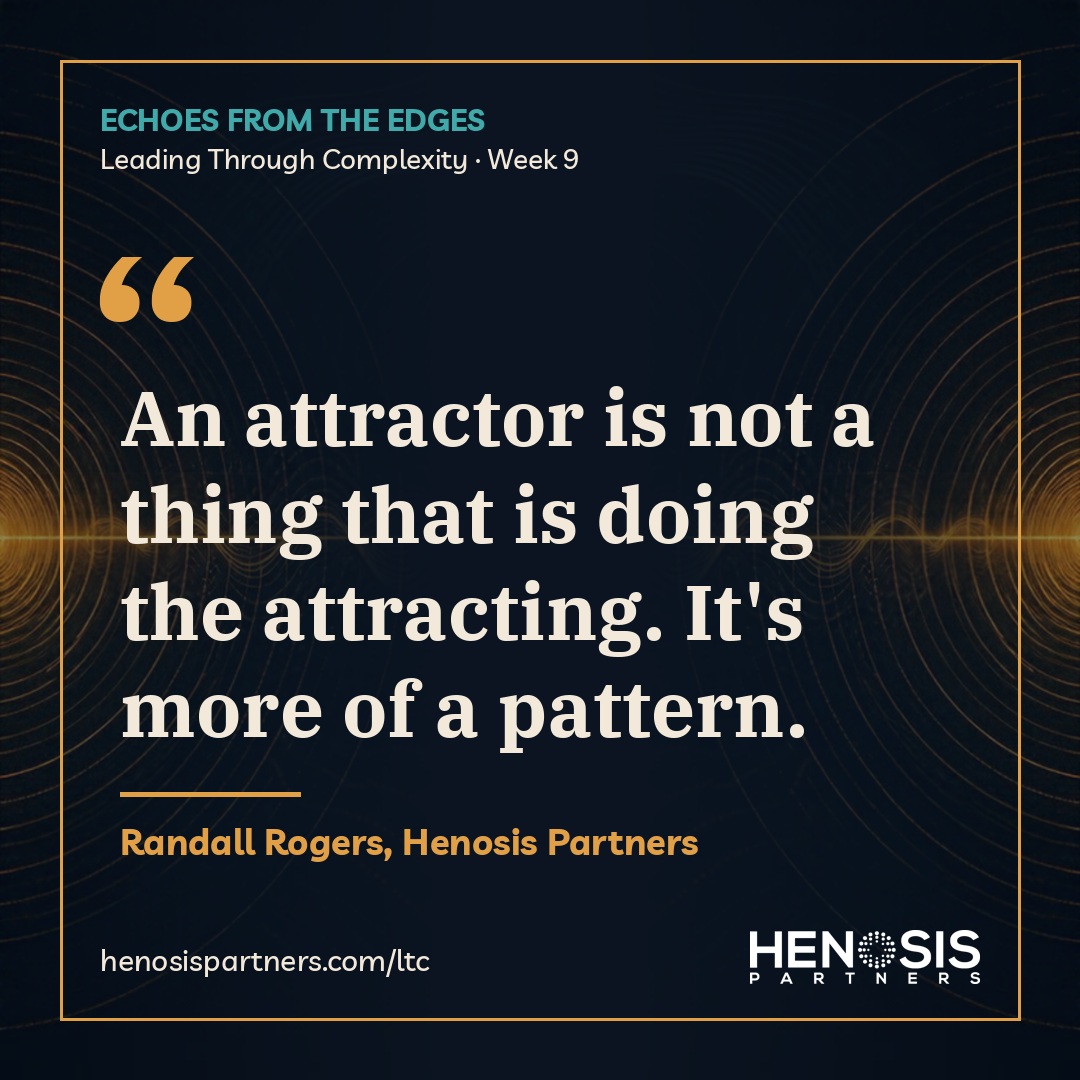
Specifically, it's a pattern of relating and behaving towards which a system tends over time. It's a trajectory. Nobody is pulling the system back to the old way. The system's own interactions, constraints and history keep reproducing it.
We all live with everyday attractors. Think of the route you drive to work, the seat you take in a recurring meeting, or the way a family conversation always ends up in the same argument. None of these are imposed. They emerge, and they're self-reinforcing.
Culture: The Classic Attractor
In organizations, the classic example of an attractor is culture.
"Folks at the top, top down, they don't create culture."
What creates culture is the relationships and interactions among people, all of it mashed together. The sum of that is an organization's culture, and culture is a major attractor within an organization.
This explains why culture-change programs built on posters, values statements and leadership speeches so rarely work. They address the visible surface and leave untouched the patterns of interaction and the constraints that produce the culture. As the chemist Ilya Prigogine observed of complex systems, they carry their history on their back.
Attractor Wells and Their Gravity
In Week 7, we saw how assemblage maps reveal attractor wells: clusters of stories and behavior that the system keeps falling into. Each well has a gravitational pull. Shallow wells are easy to climb out of. Deep, entrenched wells, built over years of reinforcing interactions, are very hard to leave.
That's why I tell every cohort:
"Escape velocity is real."
Depending on how entrenched an attractor is, its gravitational pull will determine the amount of escape velocity needed to shift from pattern A to pattern B.
What Creates Escape Velocity?
The way I define it, escape velocity is a function of two things working together:
The changes we've made to dark constraints, both directly and indirectly. These are the assumptions, beliefs and biases that hold the pattern in place from the inside (Weeks 3 and 4).
The changes we're making to governing constraints through our probes. These are the policies, processes, structures and incentives that hold it in place from the outside (Week 8).
When we do both well, we can chip away at the undesirable attractor regime and build desirable ones. When we do a poor job, it's going to be hard for people to escape those undesirable regimes, no matter how good the workshop was.
A Dual Strategy: Dampen and Amplify
This leads to a practical, two-handed strategy for complexity leaders:
Dampen the patterns you want less of by weakening the constraints that feed them.
Amplify the patterns you want more of by strengthening, resourcing and making visible the probes and stories that point in your direction of travel.
With each probe, we're altering the dispositional state of the system: what is possible and what can emerge. Change happens not through one big push, but through many small shifts that gradually make a new pattern more attractive than the old one.
Rethinking Resistance
Seen through this lens, much of what we call resistance isn't people refusing to change. It's people being pulled by a pattern that's stronger than the change we've introduced. That reframe matters, because it moves the conversation from blaming individuals to redesigning conditions.
Try This
Name one pattern in your organization that keeps coming back. Then list three dark constraints (beliefs or assumptions) and three governing constraints (rules, processes or incentives) that keep it in place. Which one could you change in the next month?
Watch the Short
Watch on YouTube: An Attractor Is Not a Thing
Watch on YouTube: Escape Velocity Is Real
Subscribe to Echoes From the Edges for more: Echoes From the Edges on YouTube
More From This Series
Keep Learning
Want a practical starting point? Download the free Hybrid OD e-book and see how diagnostic and dialogic methods combine to tackle complex change.
Ready to go deeper? Leading Through Complexity is our live 12-week program for OD, change and transformation leaders. The next cohort begins in 2027 and is limited to 50 participants. Join the waitlist.
FREE MINI COURSE: Go deeper with The Age of Complexity
6 short video lessons (about 33 minutes) from Leading Through Complexity on why proven change methods fail, and what to do instead.
Get the Free Mini Course →