- Today
More Like This, Less Like That: Find a Direction of Travel
- Randall Rogers
- 0 comments
From Week 7 of Leading Through Complexity
Week 7 begins the dialogic sequence of the Complexity Leadership Model, Steps 2 through 4: assess where we are, determine where we want to go and assess what we can change. It's also where we introduce one of the most practical tools in the course.
The Problem with "How Do We Improve…?"
Most change efforts start with an improvement question. How do we improve customer service? How do we improve patient care? How do we improve collaboration?
These questions sound reasonable, but in a complex system they have two problems. They assume we already know what "improved" looks like, and they're so broad that no one knows where to start. They tend to produce big programs, long plans and, eventually, resistance.
A Better Question
In complex change, we don't set a fixed destination. We set a direction of travel, and we describe it in terms of the stories people tell.
"Instead of maybe asking how do we improve customer service, we would ask how do we generate more stories of satisfied customers and fewer stories of unresolved complaints."
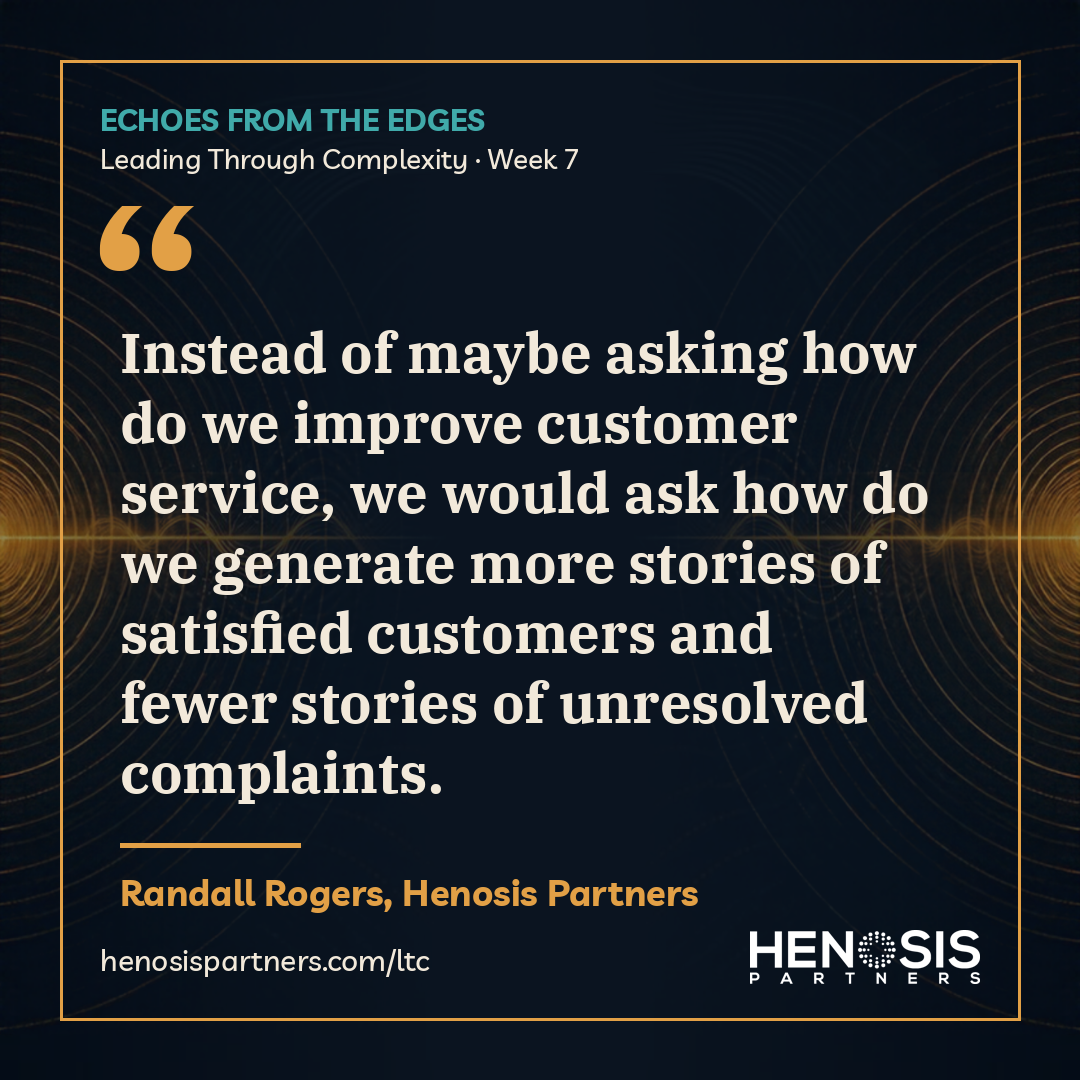
Similarly, instead of asking how we improve patient care, we could ask how we create more stories of patients feeling empowered and fewer stories of patients feeling unheard during their care.
This simple reframe, more like this, less like that, does a lot of work:
It's grounded in reality. The "this" and "that" come straight from the stories harvested in the diagnostic sequence, so it describes patterns people recognize.
It's actionable. Anyone, at any level, can ask: What could I do this week to create more stories like this one?
It's measurable indirectly. You can track whether the mix of stories is shifting over time, without pretending you can predict exactly how.
It invites experimentation. There's no single right answer, just many small ways to nudge the pattern.
Where Are We? Assemblage Maps
Before setting a direction of travel, we need a shared sense of where we are. In Week 7, we work with assemblage maps: visual maps that place the harvested stories and their patterns so the system can see itself.
What these maps reveal is fascinating. Stories don't scatter randomly. They cluster into what are called attractor wells, stable patterns of behavior and meaning that the system keeps returning to.
Why Change Is Hard: The Gravity of Attractor Wells
Attractor wells have a gravitational force to them. The deeper the well, the stronger the pull and the more difficult it is to escape. That's why people slide back into old patterns even after a successful workshop, a new policy or a restructure.
"Your role as a complexity leader is to help sort of shift them from well to well. And it's easier said than done."
It's easier said than done because we usually try to address that kind of complex, adaptive change with a technical solution, and it never works. A new process doesn't change the gravity of a well. Changing the constraints that hold the well in place, and running many small experiments that make a different pattern more attractive, does.
We'll go much deeper into attractors and escape velocity in Week 9. For now, the key insight is that resistance is often not about people. It's about the pull of the pattern they're in.
What Can We Change?
The final step of the dialogic sequence asks a pragmatic question: of all the constraints holding the current patterns in place, which ones can we actually change? We can't change them all, but we can probably change many. Those become the focus of the experiential sequence and the safe-to-fail probes in Week 8.
Try This
Take an improvement goal you're working on and rewrite it as a direction of travel:
"How do we create more stories of ______ and fewer stories of ______?"
Then share it with three people who live with the challenge every day and ask: What's one small thing we could try this week?
Watch the Short
Watch on YouTube: More Like This, Less Like That
Subscribe to Echoes From the Edges for more: Echoes From the Edges on YouTube
More From This Series
Keep Learning
Want a practical starting point? Download the free Hybrid OD e-book and see how diagnostic and dialogic methods combine to tackle complex change.
Ready to go deeper? Leading Through Complexity is our live 12-week program for OD, change and transformation leaders. The next cohort begins in 2027 and is limited to 50 participants. Join the waitlist.
FREE MINI COURSE: Go deeper with The Age of Complexity
6 short video lessons (about 33 minutes) from Leading Through Complexity on why proven change methods fail, and what to do instead.
Get the Free Mini Course →